
Understanding the Fundamentals: What is Supply Chain AI and Why Does it Matter?

What is Supply Chain AI?
Supply chain AI means using artificial intelligence to analyze data, predict events, and automate decisions across the supply chain. It combines machine learning, natural language processing, and optimization to turn raw data into actionable insight. Think of it as a smart assistant that spots patterns humans miss and suggests precise steps to improve flow.
Key components you’ll use
- Predictive analytics: forecast demand, lead times, and disruptions before they happen.
- Prescriptive analytics: decide the best actions to take given a forecast and constraints.
- Demand sensing: shorten the typical forecasting horizon to react to real-time signals.
- Inventory optimization: balance service level with carrying costs using data-driven rules.
- Supplier risk scoring: rate supplier reliability and exposure to events like strikes or weather.
Why it matters to operations and profits
AI changes decisions at the speed of data. It reduces stockouts, lowers excess inventory, and shortens cycle times. The payoff shows up as higher order fill rates, steadier production, and lower total costs. You’ll move from reactive firefighting to proactive, data-backed planning.
Where AI starts making an impact
- Planning: align demand, supply, and capacity with accurate forecasts.
- Execution: automate replenishment, routing, and scheduling based on real-time signals.
- Supply management: monitor supplier health and adjust sourcing quickly.
- Product lifecycle: adapt to changes in mix, seasonality, and promotions.
Practical indicators of AI readiness
- Data maturity: clean, centralized data with labeled history for at least 12–24 months.
- Process discipline: standard rules for ordering, replenishment, and exception handling.
- Cross-functional access: shared dashboards for procurement, operations, and logistics.
- Decision velocity: a culture that tests, learns, and scales quick wins.
Common capabilities you’ll deploy first
- Demand forecasting models: compare time-series, causal, and ML approaches; choose the simplest that works.
- Inventory optimization: automate stock targets by location and product family.
- Pricing and promotions optimization: forecast impact and adjust offers without overreacting.
- Dynamic replenishment: trigger orders based on real-time signals like drift in demand or supply delays.
Risks and how to mitigate them
- Bias in data: test models on diverse periods and scenarios; refresh data regularly.
- Overfitting: prioritize explainable models and validate with out-of-sample tests.
- Change management: pair analytics with clear ownership and upskilling for teams.
- Security: implement strong access controls and monitor for data breaches.
What success looks like in the first 90 days
- Baseline metrics: track forecast accuracy, inventory turns, and fill rate.
- Quick wins: automate a low-margin, high-volume replenishment process to free time for deeper work.
- Win in one area: demonstrate a 5–15% reduction in stockouts or a similar improvement in cycle time.
Next steps you can take today
- Audit data readiness: inventory records, demand signals, supplier scores, and transit times.
- Define a pilot scope: pick one product family, one region, and a measurable outcome.
- Choose a partner approach: decide between building in-house capabilities or partnering with an expert vendor for rapid results.
Supply Chain AI is not a black box; it’s a decision-support tool that sharpens your planning, speeds execution, and strengthens resilience. Start with clean data, clear metrics, and a focused pilot. Let measurable wins guide broader adoption and sustained impact across your operations.
Practical Applications: Real-World AI Solutions for Supply Chain Optimization
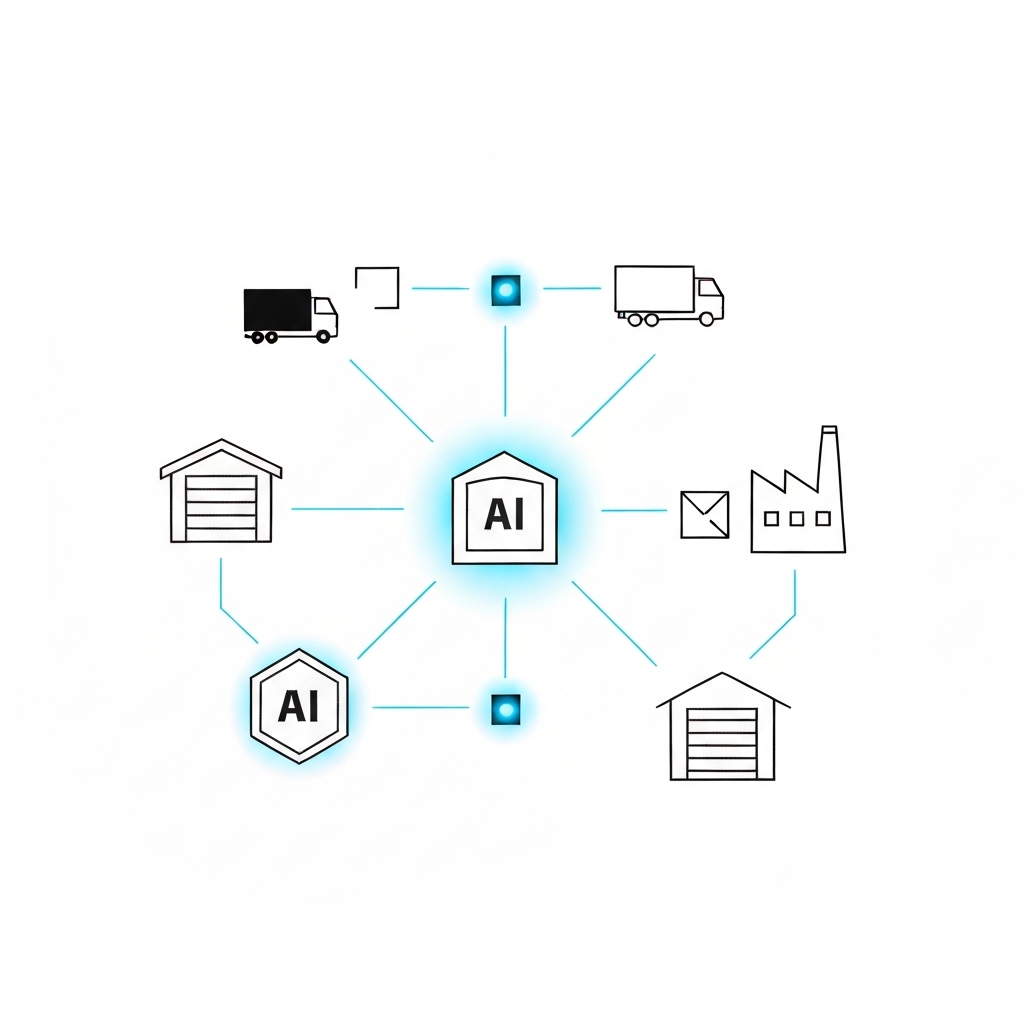
Practical AI solutions can turn supply chain data into fast, decisive actions.
Here are real-world use cases and how to implement them with a focus on measurable outcomes.
Demand Sensing and Forecasting
Use AI to detect short-term demand signals from sparse data. Combine internal data (sales, inventory, promotions) with external signals (weather, holidays, macro trends). Start with a rolling forecast that updates daily or hourly during spikes.
Track accuracy with metrics like MAE and MAPE, and set a target improvement of 15–25% in forecast error within 90 days. Quick wins come from adjusting safety stock and replenishment rules based on the updated forecasts.
Dynamic Inventory Optimization
AI models optimize reorder points, safety stock, and lot sizes across multiple locations. Tie optimization to service level targets and cash flow goals. Implement a constraint-aware planner to avoid stockouts while reducing excess inventory by 10–20% in the first quarter. Use scenario planning to test changes in lead times, capacity, and demand shifts before locking in policy changes.
Supplier Risk Scoring
Train models on supplier performance data, lead times, quality defects, and financial health. Generate a risk score that flags critical suppliers and predicts potential disruption.
Use these scores to shift orders, diversify sourcing, or negotiate improved terms. Start with quarterly reviews and a 90-day monitoring window to validate the model’s early alerts against actual incidents.
Transportation Routing and Load Optimization
Apply AI to optimize routes, consolidate shipments, and balance carrier reliability with cost. Start with a two-step approach: first, optimize for cost per mile; second, incorporate service levels and carbon footprint. Measure impact with total landed cost and on-time delivery improvements.
A practical baseline is a 5–10% reduction in freight spend within six weeks of deployment.
Predictive Maintenance for Logistics Assets
Use AI to predict breakdowns for warehouses, forklifts, conveyors, and dock equipment. Schedule maintenance before failures occur to cut downtime. Tie maintenance schedules to push rates and order cycles to minimize disruption. Target a 15–25% reduction in unplanned downtime within 90 days of implementation.
Quality and Yield Analytics
Apply AI to monitor process quality across packaging, sorting, and assembly lines. Detect patterns that lead to defects and reroute workflows in real time. Start with lightweight anomaly detection on key quality KPIs and escalate to prescriptive actions (machine adjustments, process changes) as you gain confidence. Expect a steady drop in defect rates and scrap costs after a focused 60–90 day rollout.
End-to-End Traceability and Visibility
Leverage AI-driven dashboards to fuse data from ERP, WMS, TMS, and supplier portals. Use real-time alerts for exceptions, delays, and inventory imbalances. Build a single source of truth that supports root-cause analysis and faster decision-making. Align alerts with incident response playbooks to reduce mean time to recovery by 20–40%.
Pricing and Promotion Optimization
AI helps price-sensitive items by analyzing demand elasticity, competition, and inventory levels. Use guardrails to protect margins while staying competitive. Run A/B tests on pricing rules and measure lift in revenue per SKU with minimal risk of stockouts. A practical goal is a 2–5% uplift in gross margin for promotional periods.
Scenario Planning for Disruption Readiness
Build AI-enabled scenario models that stress-test supply chain networks under disruption. Include factors like supplier failure, port congestion, and sudden demand spikes.
Use a decision framework with pre-defined action triggers (rerouting, supplier escalation, capacity reallocation). The value lies in faster validation of options and fewer reactive moves during real events.
Data Hygiene and Governance
AI only shines with clean data. Establish data quality rules, lineage tracking, and governance gates. Start with a minimal viable data model: core attributes, a single source of truth, and automated cleansing. Regularly audit data latency and completeness to keep models accurate. A disciplined data layer reduces model drift and increases trust across teams.
Operational Playbooks and Automation
Convert AI insights into repeatable actions. Build automated workflows that translate alerts into tasks for planners, procurement, or logistics teams. Pair automation with human oversight for exception handling. Track the adoption rate of recommended actions and tie it to KPIs like cycle time and service levels.
Implementation Checklist
-
- – Build cross-functional squads to own end-to-end outcomes.
- – Align AI initiatives with KPI systems to demonstrate financial impact.
- – Use short feedback loops: daily or weekly evaluations to adjust models.
- – Keep data sources limited enough to govern, yet rich enough to be predictive.
- – Start with high-impact, low-risk pilots that produce measurable wins.
- – Define concrete objectives and success metrics for each use case.
Measuring ROI
Link AI outcomes to cash flow, not just accuracy. Track reductions in inventory carrying costs, freight spend, and lead-time improvements. Calculate ROI as net benefits minus deployment costs over a 6–12 month horizon. Use simple dashboards that translate model outputs into business-ready numbers for executives.

Practical steps to plan AI adoption
Start with a focused use case map. List current pain points, quantify potential value, and rank by impact and feasibility. Prioritize use cases that improve accuracy, speed, or visibility in core processes such as demand planning, inventory optimization, and supplier risk screening.
Build a data readiness plan. Audit data quality, availability, and lineage. Create a lightweight data catalogue that catalogs sources, owners, and update frequencies. Ensure data is secure, governed, and accessible to the AI tools you pick.
Choose a horizontal AI platform or best-of-breed approach. A platform speeds onboarding and governance. A best-of-breed stack can optimize specialized tasks but may require more integration work. Align choice with your team’s skills and your governance model.
Implementation blueprint

- Pilot with a tightly scoped project. Run for 6–12 weeks, measure a few KPIs, and learn quickly.
- Define success metrics early. Examples include forecast accuracy, stock-out rate, and working capital days.
- Use incremental integration. Connect data sources in small, testable steps to avoid large disruption.
- Embed AI into decision workflows. Build guardrails and human-in-the-loop checkpoints for critical choices.
- Automate monitoring. Set alerts for data drift, model performance decay, and unexpected outputs.
Develop governance and change management. Create an AI steering committee, assign owners, and publish clear policies for data use, privacy, and compliance. Communicate benefits and changes to those in the trenches to reduce friction.
Operational improvements from AI integration
Demand planning gains come from probabilistic forecasting. Combine historical data with external signals like seasonality, promotions, and macro trends. Use ensembles to improve stability during volatility.
Inventory optimization benefits from real-time signals. AI can adjust safety stock and reorder points dynamically based on lead times, demand volatility, and service level targets.
Supply risk becomes visible earlier. Machine learning can score supplier risk, flag bottlenecks, and suggest mitigation actions such as dual sourcing or buffer contracts.
Performance dashboards that matter
- Forecast accuracy by product family and region.
- Inventory holding cost vs. service level.
- Lead time variability and supplier risk scores.
- Plan vs. actuals with drill-down capabilities to actions taken.
Keep dashboards actionable. Provide concrete next steps with ownership and time frames when anomalies appear.
Data considerations and pitfalls
Data quality drives AI success. Clean, complete, and timely data reduces false signals. Implement simple data quality checks at source and during ETL to catch gaps early.
Avoid data silos. Cross-functional data sharing unlocks richer models. Establish data contracts between teams to ensure consistency across planning, procurement, and logistics.
Guard against bias. Regularly audit models for biased outputs that could hurt suppliers, regions, or products. Use fairness checks and keep human oversight for sensitive decisions.
Technology and architecture basics
Leverage cloud-based AI services for scalability. Start with ready-made models for forecasting, anomaly detection, and optimization, then customize as needed.
Integrate with existing ERP and WMS systems via well-documented APIs. Aim for a modular architecture so you can swap tools without rebuilding workflows.
Ensure security and compliance. Apply role-based access, data encryption, and regular vulnerability reviews. Keep audit trails for all AI-driven decisions.
Future trends to watch
Adaptive planning will drive responsiveness. AI will adjust plans in real time as data flows in, enabling near-instant recovery from disruptions.
Explainable AI becomes standard. Stakeholders will demand transparent rationale behind AI decisions, especially in procurement and capacity allocation.
Edge AI expands. On-site sensors and local models will reduce latency in manufacturing and last-mile logistics.
Collaborative AI networks will emerge. Firms may share anonymized signals to improve collective forecasting and resilience without exposing sensitive data.
- Start with a learning loop. Implement small pilots, measure results, and scale what works. Treat each iteration as a chance to refine data quality and governance.
- Invest in people and processes. Train teams on AI basics, data stewardship, and decision-making under uncertainty. Create playbooks for common AI-enabled actions.
- Maintain a clear value narrative. Tie AI initiatives to concrete financial outcomes like cash conversion cycle improvements, reduced stockouts, and higher order fill rates.