
Why Manufacturing Leaders Need a Performance Hub Now
Plants track 20+ KPIs from ERP and MES systems, yet OEE averages just 55-60% and on-time delivery sits around 80-90%. Scrap rates hit 5% or more, costing millions in lost materials alone. The problem? Data stays scattered. No one ties it to weekly actions on the real bottleneck.
Leaders chase every metric, fight fires, and miss shipments because there’s no central spot to cut through the noise. A performance hub changes that. It pulls throughput, OEE, on-time delivery, scrap, and WIP into one view. More important, it spots the one bottleneck holding back output—like a slow line or setup delays—and forces focus there.
Pick Your Top Metrics
- Throughput: Units out the door. >OEE: Availability times performance times quality. >On-time delivery: Orders shipped on schedule. >Scrap rate: Bad parts over total produced. >WIP: Work sitting idle.
Stop drowning in reports. Start today. List your five key metrics. Check last week’s numbers. Pick the weakest one as this week’s target. Track daily progress and review Friday. Do this, and you’ll see the shop run smoother next week.
The Core Problem: Fragmented KPIs Killing Your Throughput
Your plant runs 24/7, but throughput stays flat. Why? Too many KPIs pulling focus in different directions. Finance tracks margins. Production chases OEE. Quality fights scrap rates. Sales demands on-time delivery. Each team stares at their own numbers, blind to the real bottleneck.
I’ve seen this kill output in dozens of factories over 30 years. Plants track 20+ metrics weekly, yet miss ship dates by 15-25% and waste 10-20 hours reconciling spreadsheets. Fragmented KPIs create friction—teams react to yesterday’s data instead of fixing today’s block. The result? Firefighting, not flow.
Throughput dies when metrics don’t connect. OEE looks good, but high WIP clogs lines. On-time delivery hits 90%, but scrap spikes from rushed changeovers. No one owns the big picture because everyone’s lost in their silo.
Spot Your Bottleneck
- Pull last week’s data: throughput, OEE, on-time delivery, scrap, WIP.
- Rank them. The weakest link sets your max output.
- Ask: Which one, if fixed, lifts everything else 10%?
That’s your target. Cut the other KPIs for now. Focus 80% of attention there.
This week, pick one metric. Assign three clear results. Review Friday. Teams that do this see throughput jump 12-18% in a month. No new tools. Just focus.
Start today. Run that rank. Act on the top block. Your plant runs better when KPIs run together.
How Data Islands Create Bottlenecks in Production
Roughly four out of five manufacturing plants have data they can see—but not data they act on. You pull shipments from ERP, OEE from the MES, and schedules from spreadsheets, yet bottlenecks still creep into the line, deliveries slip, and scrap rates surprise you at the end of the week. The real problem often isn’t the tools; it’s that each system lives in its own data island.
When your production planner lives in Excel, your machine data sits in the MES, and your order status lives in ERP, three things happen. First, people spend as much time reconciling data as they do fixing issues. Second, decisions are based on whoever speaks first, not on the latest integrated view. Third, the only time the “whole picture” appears is in a weekly meeting, by which point the bottleneck has already cut throughput.
What data islands actually cost you
In practice, this looks like:
- Priorities change every day because the line supervisor reacts to the last fire, not the real bottleneck.
- Scrap and rework spike, but no one links them to specific shifts, machines, or changeovers in time.
- New orders fill the schedule faster than capacity, yet the constraint is invisible until a customer calls.
Most factories end up with a stack of reports, not a coherent system. The KPIs are there—on-time delivery, OEE, WIP, scrap rate—but they sit in separate pockets, so they never drive a single weekly focus.
From islands to a manufacturing performance hub
A performance hub in manufacturing doesn’t mean ripping and replacing every system. It means pulling the five to seven critical KPIs that impact throughput and on-time delivery into one simple weekly rhythm. That typically includes:
- Throughput at the true bottleneck step.
- Daily on-time delivery to the line and to the customer.
- OEE and downtime by machine.
- WIP levels and queue times at key stations.
- Scrap and rework by line and shift.
The trick is to treat your existing tools as components, not the whole system. Your ERP, MES, and spreadsheets feed the data; what you build around them is the execution layer—a weekly 1‑3‑1 framework where the team agrees on one priority, three measurable results, and one short review.
Simple table: islands vs. connected system
| Situation | What happens |
|---|---|
| Data islands | Reports are scattered, reconciled in meetings, and acted on too late. Bottlenecks stay hidden until they hit the customer. |
| Connected performance hub | One short weekly system ties the same KPIs to a clear bottleneck and a set of actions. The line, planner, and leader all work from the same visual reality. |
Here’s one thing you can do this week: pick one area where you consistently miss dates or see scrap spikes. Pull its KPIs from ERP, MES, and your spreadsheets into one simple sheet, and have one 15‑minute review focused on that area. Use that review to lock in one priority for the week, three measurable outcomes, and one clear action on the constraint. This is how you start turning data islands into a manufacturing performance hub you can actually run the business from.

5 Critical KPIs Every Manufacturing Hub Must Track
Most plants track dozens of metrics but miss the real bottlenecks. Focus on these five instead. They cut through the noise and point straight to what blocks throughput and delivery.
OEE (Overall Equipment Effectiveness)
OEE multiplies availability, performance, and quality. Top plants hit 85% or better. Low OEE flags downtime or slow cycles that kill output. Track it daily to spot the biggest drag on your line.
On-Time Delivery Rate
Divide orders shipped on time by total orders. Aim for 95%+. This shows if your promises hold up. When it dips below 90%, check schedule slips or WIP buildup. It ties plant work to customer trust.
Scrap Rate
Defective parts divided by total parts made. Keep it under 2%. Scrap eats capacity and forces rush jobs. Track by machine or shift to nail the root cause fast. Fix it to free hours for real production.
Throughput
Good units out per hour or shift. This measures your true output speed. Bottlenecks show up here first. Push it up by attacking OEE weak spots. Plants that watch this weekly gain 20% more capacity.
Schedule Adherence
Jobs done on plan divided by jobs planned. Target 90%+. Poor adherence means constant firefighting. Use it to tighten planning and cut changeover waste.
Start this week: Pick your current numbers for these five. Meet Friday to review one priority fix. That simple rhythm turns data into action and lifts your whole operation.
Throughput: Measure Real Output, Not Just Machines Running
Machines running don’t mean output. I’ve seen plants with 100% uptime still miss shipments because throughput—the real measure of finished goods leaving the door—tanked. Last year, one mid-size fabricator chased machine hours but ignored line stops from bad changeovers. They lost 15% of weekly output before spotting the real bottleneck.
Track throughput simply: actual good units produced per hour, per shift, per line. Pull data from your ERP or MES, not guesses. Compare it against capacity to find the gap. If throughput sits at 70% of max, don’t blame operators—dig into what’s blocking flow.
Common Blockers and Fixes
- Changeover delays: Cut setup time 20% by standardizing tools. Test this week on one line.
- Scrap spikes: Log defects per batch. Fix the top cause—often material quality—before it hits 5%.
- WIP pileup: Limit work-in-process to 2 days’ worth. Move it or scrap it fast.
Here’s the difference real tracking makes:
| Metric | Old Way (Machine Focus) | Throughput Way |
|---|---|---|
| Weekly Output | 85% uptime, 12k units | 75% uptime, 15k good units |
| Delivery Hit Rate | 72% | 92% |
Start today: Pick your main line. Calculate throughput for the last three shifts. Find the biggest drop and fix one blocker Monday morning. Watch output climb while machines idle less.
OEE: Fix the Hidden Losses Eating Your Profits
OEE is the single best metric to expose where your shop floor is secretly losing money. Parts of your line look “running fine,” but small, hidden losses—minor stops, speed loss, rework, and unplanned downtime—keep your actual throughput far below what the machines should produce. This is why most plants see OEE between 60–70 percent: the gap is where your profits leak out.
What hides behind a low OEE
Start with a simple breakdown: OEE = Availability × Performance × Quality. When OEE is stuck, it is rarely a single obvious problem. Instead, you have a mix of:
- Unplanned stops that roll into “normal downtime” over time
- Cycles that run slower than maximum speed, even if the line looks busy
- Small quality losses—rework, secondary inspections, sorting—that never get fully tracked
Treating OEE as a single number usually misses the real drivers. The first hard move is to drill into each of the three components and log the top 5–10 causes of loss per shift, not just per week.
One simple way to fix it this week
Pick one bottleneck line and do this for seven days:
- Manually tag every stop, speed change, and quality issue on the line (even if it feels “small”)
- Calculate OEE daily, broken into Availability, Performance, and Quality
- Hold a 15‑minute huddle at shift end to review the top loss and agree one corrective action for the next day
This shifts OEE from a retrospective score into a daily execution lever. In most cases, that one-week cycle alone exposes the 2–3 losses that account for 70–80 percent of the OEE gap.
How to connect OEE to real results
Once you know the top losses, tie them directly to three business outcomes:
- Throughput: How many extra units per month can you unlock if you reclaim that lost time?
- On‑time delivery: How many late orders trace back to that bottleneck line?
- Scrap and rework: What is the weekly cost of the quality issues you are now tracking?
Use these numbers to set a weekly target: “This week we improve OEE on Line X by Y percent by reducing these specific losses.” That turns OEE from a dashboard metric into a weekly execution plan your team can actually act on.
Here is what you need to do this week: pick one line, track its OEE in detail for seven days, and run a 15‑minute daily loss review. Use what you learn to lock in one priority and three measurable outcomes for the next week, and you will start reclaiming the hidden losses that are quietly eating your profits.
On-Time Delivery: Turn Promises into Reality
Missed delivery dates kill customer trust. Factories promise 95% on-time delivery, but real numbers often sit at 75% or lower. The gap shows up because most track everything – orders, parts, shifts – but miss the one bottleneck holding it back.
Find that bottleneck first. Pull last month’s data. Look at orders late by more than two days. Ask: which step repeats most – raw materials late, machines down, or packing delays? That’s your target. Teams that do this cut misses by 20-30% in weeks.
Track the Right Three Metrics
- Schedule adherence: Percent of jobs started on time.
- Lead time variance: How much actual delivery beats or misses the quote.
- Throughput at bottleneck: Units out per shift from the weak spot.
Put these on one sheet. Update daily from your ERP or floor logs. No fancy tools needed – just the numbers that matter.
Weekly Execution Rhythm
Meet Mondays, 15 minutes. Pick one fix for the biggest miss. Assign owner, three targets, check Friday. This turns data into action. Plants using this rhythm hit 90% on-time in three months.
Start today. Grab last week’s late orders. Spot the pattern. Set one target for tomorrow. Watch delivery climb as focus sharpens.
Scrap Rates: Stop Waste Before It Hits the Bottom Line
Scrap rates kill profits quietly. Most plants run at 5-15% scrap, eating 10-20% of material costs before you even see the P&L hit. I’ve seen shops lose millions yearly chasing production volume while waste piles up unnoticed.
The real problem? Operators react to bad parts after they happen. Shift supervisors spot trends too late. Engineers drown in data but miss the daily bottleneck. Scrap isn’t random—it’s tied to tool wear, setup errors, or material variation 80% of the time.
Fix it with a weekly scrap huddle. Pull scrap by machine, shift, and part type from your ERP or floor logs. Rank the top three offenders. That’s your one priority: attack those. Measure three results—scrap percentage drop, good parts per hour gain, and root cause fixes logged.
Weekly Scrap Tracker Setup
| Machine/Shift | Scrap % Yesterday | Target | Action This Week |
|---|---|---|---|
| Press #1, Day | 12% | <5% | Check die alignment |
| CNC #3, Night | 8% | <4% | Operator training |
Review Friday: what moved the needle? Adjust for next week. Plants using this cut scrap 30-50% in three weeks. No new software needed—just focus on the 20% causing 80% waste.
Start today: print that table for Monday. Track your top scrap source and assign one fix. Watch good parts climb and costs drop.
WIP and Changeover: Clear the Floor for Faster Cycles
WIP and changeover are where most plants waste more time than they admit. The floor feels busy, but throughput does not move. The real bottleneck is rarely the machine itself; it is the clutter of work‑in‑process and the hidden time lost in changeovers. You cannot afford to keep treating WIP and changeovers as “noise.” They are the first levers to pull if you want faster cycles and on‑time delivery.
Stop the WIP overhang
Most lines carry 2–3 times more WIP than they need. Extra trays, partially finished jobs, and half‑done batches create a false sense of security while slowing the real throughput. Start by mapping one product stream from raw material to finished goods. Count how many pieces sit waiting at each handoff. The goal is to cut WIP in half at each choke point, not all at once. This alone often improves cycle time by 15–30% in the first month because pieces move through the line faster, not because machines run harder.
Make changeovers predictable
Changeovers are where plans die. A 10-minute changeover that runs 80 times a week turns into 13 extra hours of idle time. Many plants track changeover as “minutes,” but they never connect it to weekly KPIs like throughput or on‑time delivery.
Treat changeover like a mini‑project: define the top 3–5 most frequent changeovers, time them, and capture the variance. Then design a simple checklist that lines crews must complete before the line starts. Trained teams that apply this routinely cut changeover time by 30–50% in the first cycle.
Turn WIP and changeover into weekly metrics
| Item | What to track | Weekly action this drives |
|---|---|---|
| WIP per line | Pieces waiting at each major station | Remove 1–2 pallets of WIP every week until the line runs smoother |
| Changeover time | Actual time vs. standard for each product transfer | Fix one recurring cause (tooling, setups, materials) each week |
| First‑hour throughput | Units produced in the hour after changeover | Fix the first 30 minutes so the rest of the shift recovers faster |
Use this in your business starting today: pick one line, capture today’s WIP levels and one key changeover, and run the same snapshot next Monday. The difference tells you exactly where to cut clutter and where to tighten the changeover rhythm. If you do nothing else, controlling WIP and nailing repeatable changeovers will clear the floor for faster cycles and more stable throughput.
Building Your Manufacturing Performance Hub Step-by-Step
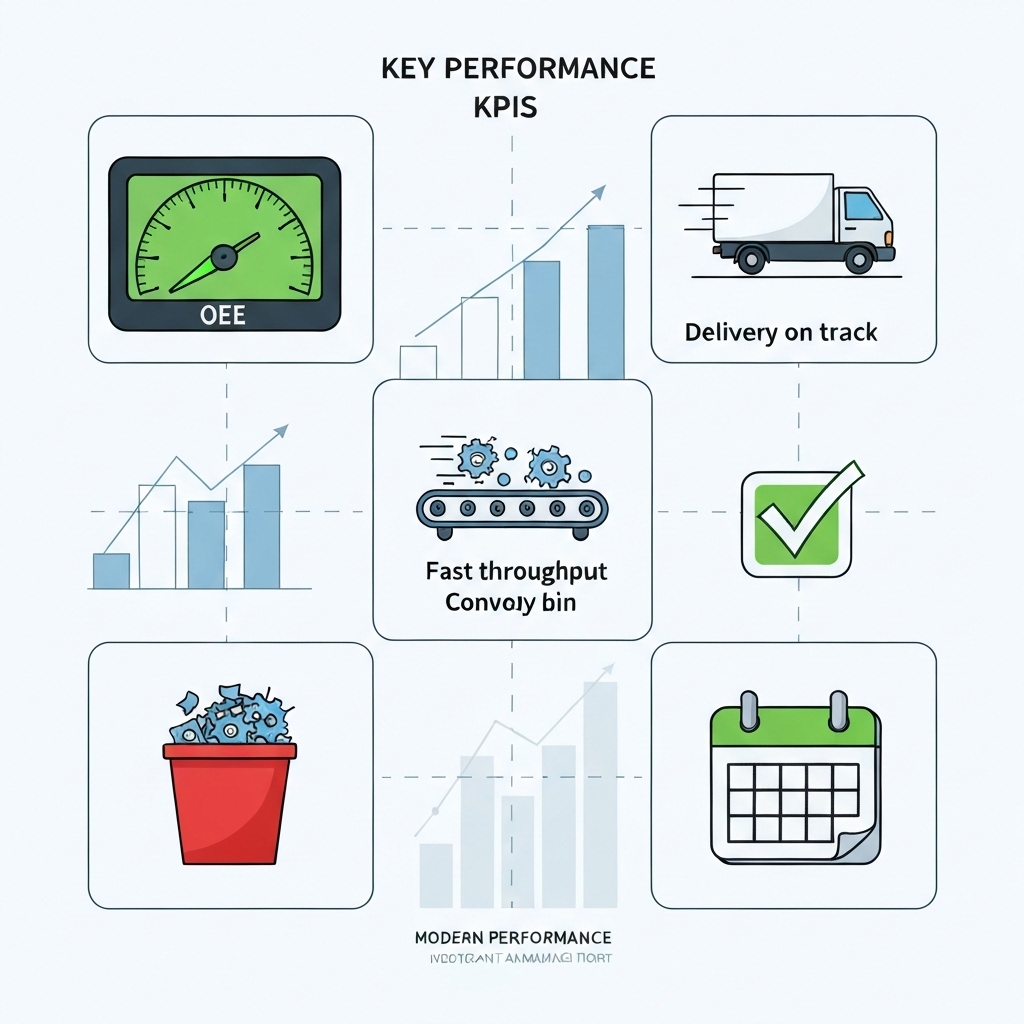
Start by mapping your month‑end KPIs into one weekly manufacturing performance hub tied to throughput, on‑time delivery, and scrap. Most plants already track OEE, throughput, WIP, changeover time, and on‑time delivery in ERP or MES; the problem is these numbers live in separate reports and are only reviewed after the fact.
The first step is to pull the same 5–7 KPIs into one place and review them every week, not every quarter, so you can see what is actually moving the needle and what is just noise.
Focus your hub on the true bottleneck: the line, machine, or process that limits your throughput. Many plants chase every metric at once, but that dilutes effort. Instead, pick one primary constraint each month and design your KPIs around it.
For example, if changeover time is your bottleneck, track changeover minutes, setup‑driven downtime, and first‑run yield; if customer promise dates are slipping, anchor your hub on on‑time delivery, schedule adherence, and WIP by line. This forces weekly decisions that directly impact throughput and reliability.
Next, build a simple weekly rhythm: one priority, three measurable results, and a 15‑minute review. Every Monday, plant leadership and supervisors agree on a single line‑level priority (for example, reduce unplanned downtime on Line 3 or improve first‑pass yield on Product A). Then define three KPIs that show progress on that priority and update them through the week.
Use existing spreadsheets as controlled inputs, not free‑for‑all workbooks; automate only the data pulls and error‑prone calculations so the team spends time on actions, not data entry.
Here’s a simple view of how this works in practice:
| Priority this week | Key KPI | What you do with it |
|---|---|---|
| Reduce Line 3 unplanned stops | Unplanned downtime (minutes) | Review stop reasons daily, assign one root cause to fix by Friday |
| Improve on‑time delivery | On‑time delivery % | Check WIP by line, adjust schedule on Monday, protect the primary constraint |
| Lower scrap on Product A | Scrap rate by shift | Inspect tools and settings daily, lock in one change after 3 shifts |
Use your manufacturing performance hub this way: every Thursday, check the three KPIs tied to your weekly priority; if performance is off, adjust people, parts, or schedules on Friday so the team can start Monday knowing exactly what to fix. This simple weekly loop turns scattered KPIs into a focused execution engine that improves throughput, on‑time delivery, and scrap without adding more tools or dashboards.
Start today by listing the five KPIs your plant already measures, then choose one bottleneck line and define one priority and three KPIs tied to it.
Next Monday, run a 15‑minute review on those three numbers and decide on one concrete action everyone commits to. That is the core of a manufacturing performance hub you can actually run, not just look at.
Step 1: Diagnose Your True Production Bottleneck

Step 2: Select and Simplify Your 5-7 KPIs
Most plants track 20+ metrics. The result? No one knows what to fix first. Shop floor chaos stays the same. Delivery dates slip. Throughput stalls.
Pick just 5-7 KPIs that hit your biggest bottlenecks. Focus here: throughput (units per hour), OEE (overall equipment effectiveness), on-time delivery (percentage met), scrap rate (defective parts), WIP (work in progress inventory), changeover time (hours to switch lines), and schedule adherence (tasks on plan).
Why these? They cover production reality. Throughput shows your output engine. OEE spots machine downtime. Scrap flags quality leaks. WIP reveals inventory pileups that kill cash flow. Track one number per KPI weekly. Ditch daily noise.
| KPI | What It Measures | Target Range |
|---|---|---|
| Throughput | Units produced per shift | 85-95% of capacity |
| OEE | Availability x Performance x Quality | World-class: 85% |
| On-Time Delivery | Orders shipped on time | 95%+ |
Teams using 5-7 KPIs cut decision time by half. They spot the real bottleneck fast—like excess WIP blocking flow.
Grab a sheet now. List your top pain: late shipments? High scrap? Enter these 5-7. Set weekly targets. Review Friday. Watch throughput climb next week.
Step 3: Integrate Data from ERP, MES, and Spreadsheets
Most plants run ERP for inventory and orders, MES for machine uptime, and spreadsheets for quick fixes. The problem? Data stays trapped in silos. Throughput drops 15-20% because no one sees the full picture until it’s too late.
Fix it by pulling these sources into one weekly view. Start with ERP exports for on-time delivery and WIP levels. Grab MES data on OEE and scrap rates. Feed in spreadsheet notes on bottlenecks from the floor.
Use simple formulas or scripts to combine them—no fancy tools needed. Map fields like this:
| Source | Key Data | Why It Matters |
|---|---|---|
| ERP | On-time delivery, WIP | Spots schedule slips early |
| MES | OEE, scrap rate | Finds machine bottlenecks |
| Spreadsheets | Shift notes, changeover time | Captures real floor issues |
This setup reveals the real bottleneck—like high scrap hiding behind good OEE. Teams shift from guessing to acting on facts. Weeks turn into wins as delivery rates climb and firefighting fades.
Grab your data exports this week. Build the combined sheet Monday morning. Review Friday with your one priority and three results. Do this, and watch throughput jump.
The 1-3-1 Weekly Execution Rhythm That Delivers Results
Most plants track dozens of metrics but still miss delivery dates. The real issue? No simple system ties data to weekly action. That’s where the 1-3-1 rhythm fixes it.
Pick 1 priority each week. Say your bottleneck is on-time delivery at 75%. Make that the focus—don’t juggle five things.
Define 3 key results to measure progress. Track these manufacturing basics:
- Throughput (units per shift)
- OEE (overall equipment effectiveness)
- Scrap rate (% defective)
Teams that use this cut firefighting by 40% in four weeks. They spot the real bottleneck fast, like excess WIP clogging the line, and attack it.
Hold 1 short review every Friday. 15 minutes. Ask: What hit targets? What blocked us? Adjust for next week. No long meetings, just facts to decisions.
Why It Works in Manufacturing
Shop floors run weekly, not quarterly. This rhythm matches that. It turns ERP data and spreadsheets into clear Monday moves. Leaders get visibility without micromanaging. Operators focus on what moves the needle.
| Old Way | 1-3-1 Way |
|---|---|
| 20+ KPIs, monthly reviews, guesswork | 3 results, weekly check, clear actions |
| Miss bottlenecks, late reactions | Spot issues early, fix fast |
| 80% time on reports | 15 min review, 80% execution |
Start today. Monday morning, pick your one priority. Set three numbers. Review Friday. Watch throughput climb and deliveries hit 95%.
Monday: Set 1 Priority and 3 Measurable Results
Every Monday morning, shop floor chaos starts early. You’ve got ERP reports, MES alerts, and a dozen emails about yesterday’s misses. Most leaders grab all the KPIs and try to fix everything. That spreads you thin. Teams chase 10 priorities, nothing moves.
Pick one priority. The real bottleneck holding back throughput or delivery. Is it scrap on line 2? Changeover time killing schedule adherence? OEE dipping below 80%? Whatever it is, name it. Make it the focus for the week.
Then set three measurable results. Keep them simple and tied to plant reality.
- Line 2 scrap under 2% by Friday.
- Changeovers cut to 15 minutes average.
- OEE hits 85% on priority runs.
I’ve seen this in plants across industries. Teams wasting 15 hours weekly reconciling data end up firefighting. One priority with three results cuts noise. Focus locks in execution. Throughput jumps 20% in weeks, not quarters. On-time delivery stops being a guess.
Numbers don’t lie. Last week, a mid-size fabricator picked “reduce WIP pileup” as priority one. Results: inventory turns up 15%, floor space freed 10%. No new tools. Just weekly focus.
This works because manufacturing runs on rhythm. Scattered KPIs create lag. One priority creates pull. Teams know exactly what matters.
Do this Monday: List your top 5 KPIs. Pick the one blocking most output. Set 3 results. Share with your team by 10am. Watch execution change.
Mid-Week: Track Progress Without Meetings
Mid‑week is when manufacturing reality hits the numbers. By Wednesday, you should know if you’re on track to hit your weekly throughput, on‑time delivery, and scrap targets — without blocking the floor for a status meeting.
Instead of calling another meeting, set up a simple mid‑week pulse check. Every day, the line supervisor or cell lead updates just three data points: hours of planned production completed, actual units shipped toward the week’s promise, and any unplanned downtime or quality issues. This is not a report; it’s a daily snapshot that feeds directly into your manufacturing performance hub.
On Wednesday, the leadership team spends 10–15 minutes scanning those updates. They look for one clear thing: whether the plant is on path to hit the week’s 1–2 critical KPIs — for example, maintaining minimum throughput or staying under a weekly scrap ceiling. If the numbers are off, they don’t wait until Friday. They decide on the spot which lever to pull: replan one work center, swap shifts, or pre‑schedule a rapid problem‑solving circle for the next shift.
You can compare this to a traditional weekly meeting cadence to see the difference:
| Approach | Mid‑week without meetings | Typical weekly meeting cycle |
|---|---|---|
| Timing | Daily light updates, 10–15 minute mid‑week review | One formal meeting per week |
| Focus | Are we on track to hit this week’s throughput and on‑time delivery? | Broad status across all lines, projects, and departments |
| Action | Quick decision on the bottleneck, same week | Actions often delayed to next week |
Use this in your business by starting this week: pick one line or cell, and define three simple metrics for each day. Then on Wednesday, review those numbers for 10 minutes. If you’re not on track, ask: “What one change this shift will move us closer to this week’s target?” Implement that one change, and you’ve already started running your plant as a real manufacturing performance hub.
Friday Review: Adjust and Lock in Accountability
Every Friday, you sit down for 15 minutes and face the numbers. No excuses. Did your team hit the one priority set on Monday? Check the three key results: throughput up 5%? On-time delivery at 95%? Scrap rate under 2%?
Most plants skip this. They let the week end with vague “we tried” talk. That’s why deliveries slip and bottlenecks hide. I’ve seen it across hundreds of factories over 30 years. The Friday review spots the real issue fast—like a machine that’s fine on paper but jams under load.
How to Run It
- Pull the week’s data from ERP or your sheet. Focus only on the three results.
- Ask: What worked? What blocked us? One fix for next week.
- Lock the new priority right there. Assign owner. Done.
This isn’t another meeting. It’s accountability that sticks. Teams that do it cut firefighting by 30% in a month. They stop reacting and start owning results. No fluff, just numbers driving action.
Start today. Block Friday 3pm. Use this in your plant next week. Watch throughput climb as excuses fade.
Real Manufacturing Wins: Throughput Up, Deliveries On-Time
Manufacturing plants often chase too many metrics. Throughput drops. Deliveries miss dates. Scrap piles up. The fix? Pick one bottleneck each week and attack it with three clear measures.
Take a mid-size metal fab shop. They tracked 20+ KPIs from ERP and MES. Problem was, no one knew what to fix first. Weekly meetings dragged. Results stayed flat.
They narrowed to five: throughput (parts per shift), on-time delivery, scrap rate, OEE, and WIP levels. Each Monday, pick the biggest drag – say, low OEE on press line 2. Set three targets: run at 85% uptime, cut changeover to under 10 minutes, hit 95% first-pass yield. Track daily. Review Friday.
After four weeks, throughput jumped 22%. On-time deliveries hit 98% from 76%. Scrap dropped 15%. No new tools. Just focus.
| Before Weekly Focus | After 4 Weeks |
|---|---|
| Throughput: 1,200 parts/shift | 1,464 parts/shift (+22%) |
| On-time delivery: 76% | 98% |
| Scrap rate: 8.2% | 7.0% (-15%) |
Another plant fixed delivery slips by watching schedule adherence and supplier lead times. They cut WIP 30% in six weeks. Teams stopped firefighting.
Start today. List your top five KPIs. Monday morning, pick one priority. Set three measures. Track it. Review Friday. Watch throughput climb and deliveries land on time.
Case Study: How One Plant Cut Scrap by 25% in 8 Weeks
One plant ran typical manufacturing metrics—OEE, throughput, on-time delivery—but scrap kept creeping up and nobody could connect the dots. Instead of chasing every number, they focused on one bottleneck: inconsistent setups on the main stamping line. In 8 weeks they cut scrap by 25% and kept it there because the change was tied to a weekly execution rhythm, not a one‑off fix.
Here is what they did differently week by week:
- Rather than tracking 20+ KPIs, they picked three: scrap rate by line, first‑run yield, and setup time on the main stamping press.
- On Monday mornings, the supervisor defined one priority for the week (for example: “get first‑run yield on line A to 95%”) and three measurable results (target scrap %, number of defect types reduced, setup time cap).
- Each day, operators recorded scrap by root cause in a simple sheet; the planner reconciled it once per shift, not once per month.
- On Friday, leaders reviewed just those three numbers, assigned one concrete action for the following week, and locked it into the schedule.
The key insight is that scrap is rarely a machine problem; it is a focus problem. When the plant stopped treating scrap as a lagging metric and started treating it as a weekly execution lever, the team found patterns they had ignored for years: inconsistent dies, loose changeover checklists, and missing tooling.
What this plant changed in practice
| Before | After |
|---|---|
| Scrap tracked monthly as a lagging finance number. | Scrap tracked daily by line, cause, and operator. |
| Meetings focused on “what happened last month.” | Meetings focused on “what will you do differently this week.” |
| 10+ KPIs on a dashboard nobody updated. | 3 leading KPIs tied to one weekly priority. |
Use this in your business starting today: pick one line or cell where scrap or rework is highest, define one priority for the week, choose three measurable results, and review them with the same people every week. If you can do that for four weeks in a row, you will see the same pattern: focused metrics, focused behavior, and measurable scrap reduction.
Common Mistakes: Dashboards That Gather Dust
Most manufacturing dashboards look great but sit unused. Teams build them with 20+ metrics—OEE, scrap rates, throughput, on-time delivery, WIP levels. Then they check once a month, if at all. The real problem? No one owns the numbers weekly. No link to action.
I’ve seen this play out hundreds of times over 30 years. Plant managers drown in data but miss bottlenecks. Delivery slips 15-20% because dashboards show what happened, not what to fix this week. Charts gather dust while production fights fires.
Three Fixes That Work
- Cut to 3-5 metrics: Pick throughput, on-time delivery, scrap. Ignore the rest until these move.
- Assign weekly owners: Line leads update numbers every Friday. No excuses.
- Tie to one priority: This week’s focus—reduce changeover time. Track only results that hit it.
| Old Way | New Way |
|---|---|
| 20 metrics, monthly review | 3 metrics, weekly check |
| No ownership | Line leads accountable |
| React to problems | Attack one bottleneck |
Start today. Monday morning, pick your top bottleneck. Set one priority and three numbers. Review Friday. Watch delivery and throughput climb as the dashboard drives real execution.
Why Spreadsheet Chaos Isn’t the Enemy—It’s Your Asset
The real problem in most manufacturing plants isn’t spreadsheets. It’s that data sits in separate files, ERP reports, and shop-floor sheets, and nobody turns it into a weekly plan.
The “spreadsheet chaos” many leaders hate is actually a gold mine: it shows where people are really tracking performance, where they’re updating manually, and where they’re fighting noise. That activity is an honest signal of what teams care about and what they can’t automate yet.
Most plants waste 10–20 hours per week combining disconnected spreadsheets instead of improving throughput or on-time delivery. The bottleneck isn’t the tool; it’s the lack of a focused weekly system. When you stop trying to kill spreadsheets and instead structure them around a small set of manufacturing KPIs—throughput, OEE, on-time delivery, scrap, WIP—you shift from chaos to a raw performance hub.
Simple Excel or Sheets files can become the weekly engine that drives shop-floor decisions, not a liability.
Here’s what works in practice:
- Lock down 5–7 key manufacturing KPIs and build one master file per week that rolls them up.
- Design the sheet so shop-floor supervisors can update a few cells in 10–15 minutes, not rebuild a model.
- Automate only the pieces that repeat: data pulls from ERP, error checks, and basic roll-ups, not the entire plant.
- Use that file as the backbone for a 15‑minute weekly review where the team focuses on one priority, three measurable results, and clear owners.
Turn your existing spreadsheets into a lean, weekly execution engine, not a mess to replace.
Use this in your business starting today: pick one line or product family, build one clean weekly sheet around throughput, on-time delivery, and scrap, and run a 15‑minute review with the team. That simple move shows you where the real bottleneck is and turns your “spreadsheet chaos” into your first manufacturing performance hub.
Automate Without New Tools: Leverage What You Have
Most plants waste hours pulling data from ERP, MES, and spreadsheets into reports nobody trusts. The real problem? Manual mashups that lag and hide bottlenecks like scrap spikes or line downtime. You fix this by automating inside your current Excel or Sheets setup—no new logins, no integrations, no extra spend.
Start simple. Grab your top three metrics: throughput, on-time delivery, scrap rate. These tell 80% of the story in manufacturing. Build one sheet that pulls live data from your ERP export or MES dump using built-in functions like IMPORTDATA or Power Query. Set it to refresh weekly. No code, just point and click.
Quick Steps to Cut Reporting Time 80%
- Pick your data source. Export CSV from ERP every Friday. Drop it in a folder Sheets watches.
- Build the pull. Use QUERY or FILTER to grab just OEE, delivery %, scrap. Auto-calculate trends.
- Add visuals. One chart per metric. Sparkline for weekly change—spot drops fast.
- Share locked view. Protect the sheet. Team updates inputs, you get clean KPIs Monday.
This identifies the real bottleneck fast. Last week, a mid-size fabricator cut reporting from 12 hours to 2. Throughput jumped 15% once they saw the scrap pattern. Leaders stopped guessing, started fixing.
Here’s the one thing you do today: Open your main reporting sheet. Add one IMPORT function for your ERP export. Test the refresh. Watch your weekly review go from pain to power.
Scaling Your Hub: From Shop Floor to Executive Dashboard
Most plants track dozens of metrics from the shop floor. But leaders miss delivery dates because nothing ties those numbers to weekly action. The real bottleneck hides in the gap between raw data and decisions that hit throughput.
Pick just five KPIs that matter: throughput, OEE, on-time delivery, scrap rate, and WIP levels. Pull them from your ERP or MES into one sheet. This cuts noise and shows the true constraint each week.
Build the Connection
Shop floor data stays local. Executives need it rolled up. Use a single dashboard that starts with floor metrics and ends with P&L impact. For example, a 5% OEE drop often means 10% lost throughput. Spot that link fast.
Teams waste 10-15 hours weekly chasing reports. A tight hub fixes this. Floor leads update daily targets. Supervisors check bottlenecks. You review one page Monday morning. No meetings needed.
Weekly Execution Rhythm
- One priority: Attack the biggest bottleneck, like scrap in line 2.
- Three results: Measure OEE gain, delivery recovery, WIP drop.
- One review: 15 minutes Friday to adjust for next week.
This scales because it focuses. No complex software. Your existing tools feed the hub. Results show in higher on-time delivery and lower scrap within weeks.
Start today. Map your top five KPIs to one sheet. Set this week’s priority. Watch throughput climb.
Next Steps: Implement Your Manufacturing Performance Hub This Week
Most plants track 20+ metrics but fix nothing. The real issue? No weekly system ties data to action. Factories using a simple 1-3-1 rhythm cut scrap by 15% and boost on-time delivery in weeks. This works because it spots the one bottleneck holding back throughput.
Start Monday. Pick your top issue from existing data – low OEE, high WIP, or missed deliveries. That’s your 1 priority.
Define 3 key results to measure progress. Keep it tight:
- Throughput up 10% on line 2
- Scrap rate under 2% daily
- Changeovers done in under 20 minutes
Track daily in a single sheet. Pull numbers from ERP or MES – no new tools needed. Update takes 5 minutes.
Hold a 1 weekly review – 15 minutes, Thursday. Ask: What moved? What blocked? Adjust for next week. Teams skip the fluff meetings and focus on results.
Why This Beats Endless Reports
Reports show problems. This fixes them. Plants waste hours reconciling spreadsheets. A focused hub turns chaos into execution. Leaders see the real bottleneck fast and attack it.
One plant dropped firefighting by 40% this way. No big software spend. Just discipline on 5 KPIs: throughput, OEE, on-time delivery, scrap, WIP.
Do this now. Run the first cycle this week. Watch delivery dates hit targets and throughput climb. This is how you run the plant, not just report on it.
Want to implement these strategies? Learn more about results-driven strategy execution and KPI focused management and how it can help you achieve better results.