
Defining Key Performance Indicators (KPIs) for Manufacturing Excellence

Let’s define KPIs that drive real results in your manufacturing operation. Start by picking metrics tied directly to your goals. These numbers will show you exactly where you stand.
Defining Key Performance Indicators (KPIs) for Manufacturing Excellence
You need KPIs that predict success, not just track history. Focus on lead measures you can influence daily. Think overall equipment effectiveness first. It combines availability, performance, and quality.
OEE tells you if machines run at peak. Calculate it as Availability x Performance x Quality. Aim for 85% or higher. Track it hourly on critical lines.
- Measure downtime minutes per shift.
- Log speed losses from setups.
- Count defect rates per batch.
Next, set cycle time KPIs. This tracks how long it takes to produce one unit. Shorten it to boost throughput. Baseline your current times, then target 10% cuts quarterly.
Pro tip: Use real-time sensors on lines for accurate data. Review variances in daily huddles.
Quality KPIs That Prevent Rework
First pass yield measures parts good on first try. Target 95% or better. Low yield signals process flaws.
- Track scrap rates by machine.
- Monitor customer returns monthly.
- Log inspection rejects per hour.
Defect per million opportunities (DPMO) digs deeper. It scales defects across volume. Use Six Sigma tables to score your process sigma level. Push from 3 to 4 sigma in six months.
Implement control charts. Plot data daily. Spot trends before they hurt output.
Cost and Efficiency KPIs
Inventory turns show how fast you cycle stock. Divide cost of goods sold by average inventory. Aim for 8-12 turns yearly in discrete manufacturing.
Overhead cost per unit tracks fixed expenses. Divide total overhead by units produced. Cut it by streamlining admin flows.
- Monitor labor efficiency: actual vs. standard hours.
- Track energy use per ton produced.
- Measure supplier on-time delivery percentage.
On-time delivery KPI hits customer trust. Calculate orders shipped on due date divided by total. Target 98%. Late shipments kill repeat business.
Safety and Sustainability KPIs
Total recordable incident rate (TRIR) keeps workers safe. Formula: injuries x 200,000 / hours worked. Zero is the goal. Review incidents weekly.
Waste diversion rate measures recycling. Track pounds diverted from landfill. Set 70% targets to cut disposal costs.
Energy intensity: kWh per unit output. Benchmark against industry averages. Install LED lights and efficient motors for quick wins.
How to Select and Cascade Your KPIs
Pick 5-7 KPIs max per department. Align them to company strategy. Use a balanced scorecard: financial, customer, process, learning.
Cascade down. Shop floor tracks OEE. Supervisors watch yield. Execs see delivery rates. Everyone sees how their work links up.
Set SMART targets: specific, measurable, achievable, relevant, time-bound. Example: “Reduce cycle time 15% by Q3 via line balancing.”
- Baseline current performance now.
- Assign owners to each KPI.
- Review weekly in 15-minute standups.
Build dashboards. Use tools like Tableau or Power BI. Make them mobile-friendly for floor leads.
Test for predictability. Ask: Does hitting this KPI predict profits? If not, swap it out.
Review quarterly. Adjust for market shifts. Reward teams beating targets. This builds ownership.
Start small. Pick two KPIs this week. Track them daily. Watch output rise as actions follow data.
Your operation transforms when KPIs guide every decision. Implement these, and excellence follows.
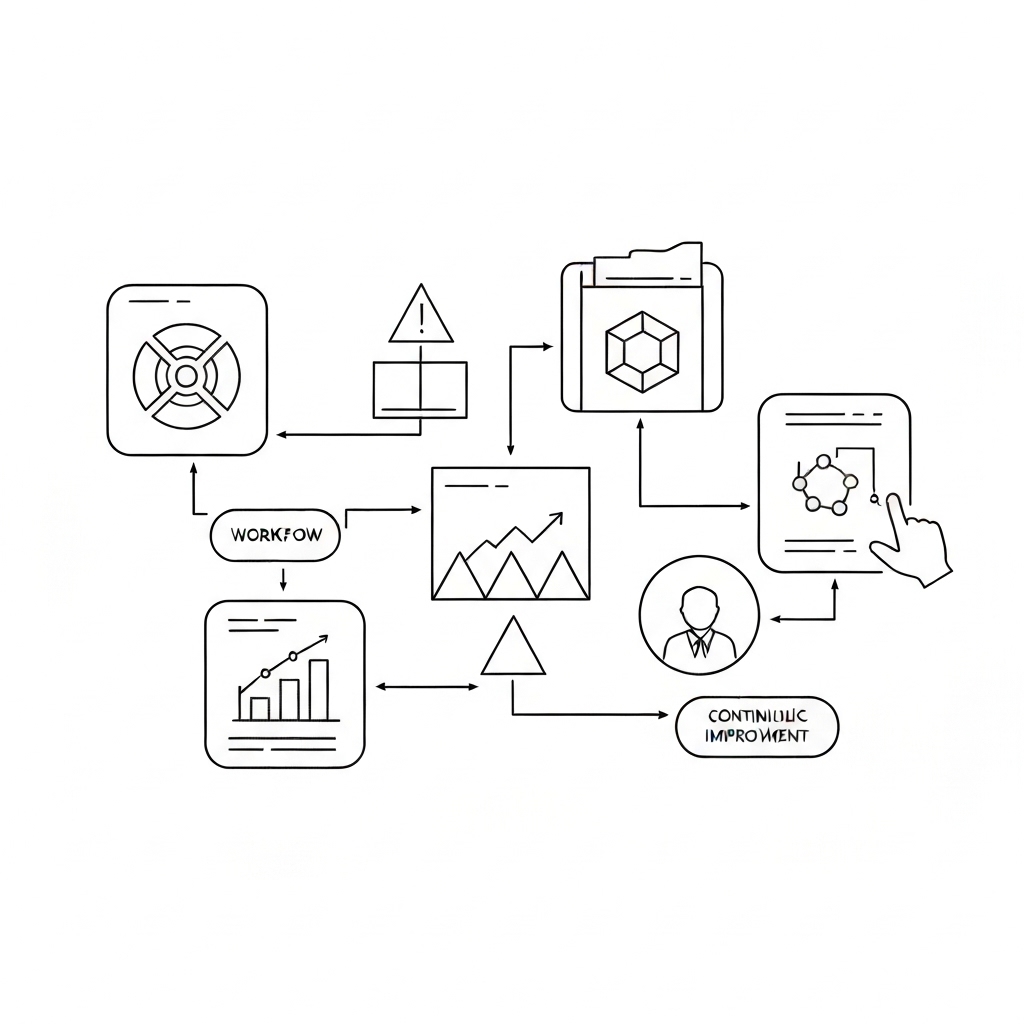
Leveraging KPIs to Drive Operational Efficiency and Continuous Improvement
KPIs are more than numbers. They are the language your team uses to see progress, spot waste, and lock in improvements. When you leverage KPIs for operational efficiency, you move from reactive fixes to proactive growth. Here’s a practical, actionable approach you can implement this quarter.
Define the right KPI set for each process
Start with process owners. Map value streams from raw materials to finished goods. For each step, pick 2–3 KPIs that directly reflect performance and impact. Examples include cycle time, first-pass yield, and overall equipment effectiveness (OEE). Use simple definitions and a clear target. Align KPIs with customer impact—on-time delivery, quality, and cost per unit.
Tips to choose effectively
- Focus on bottlenecks. A bottleneck KPI often drives the most improvement.
- Prefer leading indicators over lagging ones when possible.
- Ensure data is reliable and collected at the source.
- Limit the KPI count to avoid analysis paralysis.
Standardize data collection and visibility

Decide on data owners, sources, and routine checks. Build a simple dashboard that updates in real time or near real time. Publish banners in the shop floor for quick at-a-glance status. The goal is to reduce data gaps and eliminate guesswork.
Practical steps
- Automate data capture where possible (SCADA, ERP, MES, or IoT sensors).
- Create a single source of truth for each KPI. No round-tripping spreadsheets on a Friday afternoon.
- Set daily targets and weekly reviews with the core team.
- Use color coding to highlight red or yellow zones for fast action.
Link KPIs to deliberate improvements
KPIs should trigger specific actions. Pair each KPI with a defined owner and a 72-hour or 1-week action window. Use PDCA (Plan-Do-Check-Act) cycles to close the loop quickly.
Concrete workflows
- If cycle time rises above target, run a quick root-cause analysis and test a small change on one line first.
- If yield drops, run a 5S or standard work audit to identify deviation from best practice.
- If OEE drops, identify the biggest loss — availability, performance, or quality — and isolate the driver with a brief, focused experiment.
Embed continuous improvement into daily routines
Make data-driven improvement a habit, not a project. Create a cadence that fits your operations: stand-ups, daily huddles, and weekly improvement reviews. Keep the format simple: what happened, why it happened, what will we change, and what we expect to improve.
Simple agenda
- Yesterday’s KPI performance summary
- Top 2 drivers of variance
- One small improvement test with owner and deadline
- Barrier removal plan for the next day
Use targets and benchmarks wisely
Targets should be ambitious yet achievable. Use stage-based targets to reflect ramp-up or seasonal shifts. Compare with internal benchmarks (best line, best shift) and external benchmarks where possible, but never chase vanity metrics. Focus on metrics that move business outcomes: throughput, waste reduction, and on-time delivery.
Practical targets
- Raise overall equipment effectiveness by 3–5% within 90 days.
- Reduce scrap rate by 20% in the next quarter.
- Improve on-time delivery to 98% month over month.
Governance that prevents metric gaming
Guard against perverse incentives. If people only hit a KPI by taking short-term shortcuts, you’ll lose long-term value. Tie KPIs to customer value and process health, not just output numbers.
Controls that help
- Cross-functional reviews to validate improvements across departments.
- Audits on data integrity and change impact before adjusting targets.
- Recognition tied to sustainable improvements, not one-off spikes.
Scale KPI-driven discipline across the organization
Once you prove value on one line or one product family, replicate the approach. Create a KPI template you can reuse for other processes. Train managers to interpret data, run quick experiments, and document lessons learned.
What to scale next
- New product introductions with KPI-led gating criteria.
- Maintenance routines using predictive indicators to prevent downtime.
- Supply chain collaboration dashboards to reduce variability and clarify handoffs.
Example: tying KPIs to an improvement loop
On a mid-volume assembly line, the team tracked cycle time, first-pass yield, and OEE. A 2-week review showed cycle time creeping up due to a slower changeover. The owner tested a standardized changeover procedure, cut setup time by 15%, and documented the standard for future runs. In the next cycle, yield improved as defects dropped during changeovers, and OEE rose overall.
Actionable starter kit
- 2–3 KPIs per process with clear definitions and targets
- A single dashboard for real-time visibility
- 72-hour action window for KPI-driven improvements
- Weekly review ritual to close the loop
Bottom line
KPIs should illuminate the path to efficiency and growth. With clear targets, reliable data, and quick loops, you turn numbers into actions that deliver measurable operational gains.

Implementing a KPI-Driven Manufacturing Business Strategy for Long-Term Success
Implementing a KPI-Driven Manufacturing Business Strategy for Long-Term Success
1. Define the right KPI set for your value chain
Choose a focused group of KPIs that reflect end-to-end performance. Start with three categories: throughput efficiency, quality control, and cost per unit. Add leading indicators like on-time delivery rate, changeover time, and first-pass yield to catch issues early. Align these KPIs to strategic goals, not every metric you collect.
Practical steps
- Map your value stream and mark where bottlenecks occur.
- Prioritize KPIs that directly impact customer value and cash flow.
- Limit to 6–8 core KPIs per plant to maintain focus.
2. Cascade strategy to every level
Translate the top-level KPIs into team and shift targets. Each department should have a clear owner and a simple dashboard. When operators see how their daily work moves the needle, motivation and accountability rise.
Practical steps
- One KPI owner per metric with weekly review cadences.
- Break down targets into daily targets for frontline teams.
- Use visual boards on the shop floor to show progress in real time.
3. Implement a KPI-driven planning cycle
Embed KPI review into planning. Use data to forecast demand, schedule maintenance, and allocate capacity. A regular rhythm keeps your strategy alive and reduces reactive firefighting.
Practical steps
- Run monthly demand-to-capacity reviews and adjust production plans accordingly.
- Schedule preventive maintenance in the downtime forecast to minimize unscheduled downtime.
- Run what-if simulations to test capacity under different demand scenarios.
4. Align incentives with KPI performance
Link rewards to KPI progress to reinforce desired behavior. Ensure incentives reward sustainable improvements, not quick fixes that hurt quality or safety.
Practical steps
- Tie bonuses to a balanced scorecard of throughput, quality, and cost metrics.
- Include process improvement contributions in reviews, not just output metrics.
- Use team-based targets to promote collaboration across functions.
5. Invest in data discipline and governance
Reliable data is the backbone of a KPI-driven strategy. Build clean data pipelines, unify data sources, and ensure measurements are standardized across shifts and plants.
Practical steps
- Define measurement methods for each KPI and train teams accordingly.
- Centralize data collection with automated feeds to dashboards.
- Establish a data quality checklist and run periodic audits.
6. Leverage leading and lagging indicators
Balance lagging metrics like yield and cost per unit with leading signals such as machine health, setup times, and operator training completion. Leading indicators help you intervene before performance declines.
Practical steps
- Set thresholds for leading indicators to trigger corrective actions.
- Use small, rapid experiments to test improvements (Plan-Do-Study-Act cycles).
- Track the correlation between leading and lagging KPIs to refine your model.
7. Foster continuous improvement culture
Make improvement part of daily work. Encourage small, disciplined changes and standardize successful ones. A culture that learns from data sustains long-term success.
Practical steps
- Daily quick-hits: each shift ends with one improvement idea and a review.
- Document standard work for any process that shows measurable gains.
- Hold monthly learning reviews to share wins and failures.
8. Prioritize maintenance and reliability
Unplanned downtime destroys KPI performance. A reliability focus preserves throughput and quality, protecting long-term results.
Practical steps
- Implement a basic preventive maintenance calendar linked to KPIs like mean time between failures.
- Use root-cause analysis for recurring downtime events.
- Reserve a portion of capacity for expected maintenance windows.
9. Integrate quality at the source
Quality should be designed into the process, not inspected after. Build in-process quality checks and empower operators to stop lines when defects are detected.
Practical steps
- Incorporate poka-yoke (mistake-proofing) where feasible.
- Use real-time quality alerts and adjust process settings immediately.
- Track first-pass yield with clear owner accountability.
10. Scale with a modular rollout
Roll out KPI-driven practices in modules to manage risk and learning. Validate gains in one area before expanding to others.
Practical steps
- Start with a single line or cell and prove value within 90 days.
- Document the playbook and replicate with minimal changes elsewhere.
- Use a learning loop to refine metrics and methods across sites.
11. Embed customer value in KPI design
Ensure KPIs reflect what customers actually value—on-time delivery, quality, and responsive service. When customer outcomes drive metrics, improvements stay relevant.
Practical steps
- Map KPIs to customer requirements and service levels.
- Regularly solicit customer feedback and translate it into KPI targets.
- Prioritize initiatives that reduce cycle time and variability for customers.
12. Measure and manage risk with KPIs
Use KPIs to illuminate operational risks early. Quantify exposure and set risk-adjusted targets to keep strategy resilient.
Practical steps
- Introduce a risk dashboard highlighting capacity, supplier reliability, and process variance.
- Set contingency targets and trigger plans when risk KPIs exceed thresholds.
- Review risk KPIs quarterly with leadership and adjust the roadmap.
13. Close the loop with executive dashboards
Provide executives with concise dashboards that show progress, blockers, and next actions. Clear visibility accelerates decision-making and accountability.
Practical steps
- Limit executive dashboards to 5–7 high-impact KPIs.
- Use color-coded signals and trend arrows for quick reads.
- Link dashboards to strategic roadmaps and investment needs.
14. Prepare for the future with capability building
Develop the skills, processes, and tools needed for ongoing KPI optimization. Build a durable foundation that grows with your business.
Practical steps
- Invest in analytics training for the operations team and managers.
- Adopt scalable data platforms that handle more KPIs as you expand.
- Document best practices and create a central knowledge base for KPI management.
15. Start small, scale smart
Begin with one clear objective, prove the model, and then expand. A disciplined, iterative approach is easier to sustain than a big-bang rollout.
Practical steps
- Choose a 90-day pilot with defined targets and exit criteria.
- Capture lessons and refine the framework before broader deployment.
- Celebrate early wins to build momentum and buy-in.